Welcome to the DRD3 website
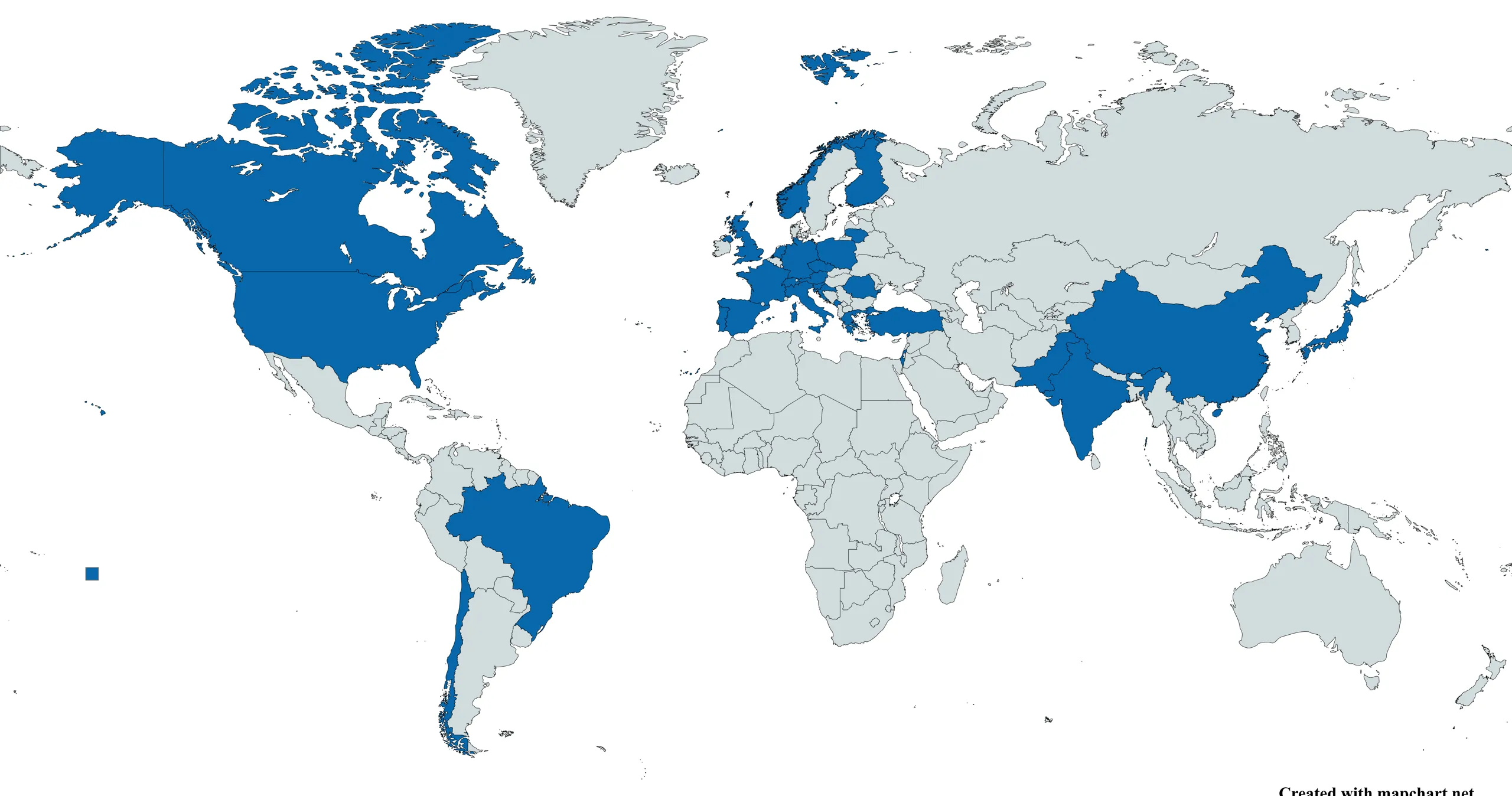
As of today:
- 537 people have subscribed to the CERN drd3-community-subscribers mailing list
- 132 institutes have subscribed to the CERN DRD3 institute egroup
Solid State detectors (SSD) based on semiconductors, and in particular silicon detectors (planar pixels, planar strips, and 3D pixels), are used in almost all particle physics experiments. Since they can be easily segmented using standard photolithographic techniques, they can achieve superb position resolution and play a key role in measuring primary and secondary vertices and tracking charged particles. Silicon is also used as an active medium in particle flow calorimeters to associate showers with tracks from trackers and track showers as they develop in the calorimeter. Revolutionary improvements of SSD performance are needed to match the requirements of future experiments. All-silicon trackers are required for future hadron colliders such as FCC-hh and are one of the most competitive options also for e+e− Higgs factories.
After years of R&D, silicon sensors manufactured using mainstream CMOS imaging technologies are now being implemented in several high energy physics (HEP) experiments. CMOS MAPS (Monolithic Active Pixel Sensor) have now been installed in STAR and ALICE; they are planned for other experiments as CBM, LHCb tracker, and Mu3e. MAPS technologies are especially suited for applications requiring low-mass and excellent position resolution called for at electron machines. Future flavour physics experiments will operate in a high-occupancy environment where event reconstruction will be very challenging. The physics program enabled by the LHCb Upgrade II relies on an efficient and precise vertex detector with real-time reconstruction of tracks from all LHC bunch crossings in the software trigger system, which would benefit from having 4D-tracking. Better position and timing resolution and lower power consumption would also benefit the upgrades of Belle and NA62, which will occur in this decade. Devices with O(10 ps) timing resolution will be highly desirable for 4D-tracking reconstruction at the foreseen 1000 collisions pile-up of the FCC-hh. One aspect common to most future facilities is the requirement for the front-end electronics to perform very complex tasks, such as those required for 4D-tracking or by the transfer off-chip of very large data volume. 3D-stacking is, therefore, a key technological development that needs to be included in the future high-performing trackers.